
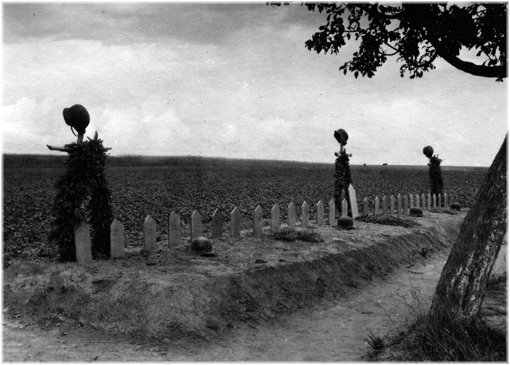

The photo shows war graves in Russia, probably in the Ukraine at about 1942. My grandfather took it. He was in Russia as a soldier and did not return home from the war. He left behind his 25 year old widow and two little daughters
The audiotape consists of two sound tracks. One of the tracks is in Russian, the other one in German. Both are dialogues from a training course including a phrase book for German Armed Forces*
The made-up dialogues of the phrase book sound unintentionally funny today. The roles are obviously assigned. The instructing, knowing German is facing the naïve and good-natured Russian civilian, who is generally hospitable, always solicitous and cooperative: “Do you understand?” – “Yes, Officer.” – “That are a lot of potatoes that you demand from a small village but I will do my best.”
There is no argument or fight. Russian civilians are clearly distinct from soldiers of the Red Army. There is no encounter with soldiers of the Red Army nor does the population hide them. The dialogues offered thus convey the absurd impression that the German invasion of Russia is only a sort of “migration to the east”. The Russian villages on the way serve as accommodation and supply. Both are given to the soldiers without any problems. History has shown that it was not like that.
I am interested in the way how the medium – in this case the course book for promotion – becomes part of an intentional delusion and stimulation of people – in this case soldiers.
The dialogically staged, peacefully hierarchical functionality of the encounter between Russian civilians and German soldiers is opposed to my grandfather’s painful presentiment that he would not return from this war, expressed in the numerous photographs of graves that he took. The certainties of our lives are stronger than our staging.
* In: THE EAST. Special training course with general educational objectives. 2nd Part. 47th anthology of the series “Letters for the promotion of soldiers”. Edit: High command of the German Armed Forces. Breslau/ Leipzig 1942
To the texts
(Photo: Heinrich Vernekohl)